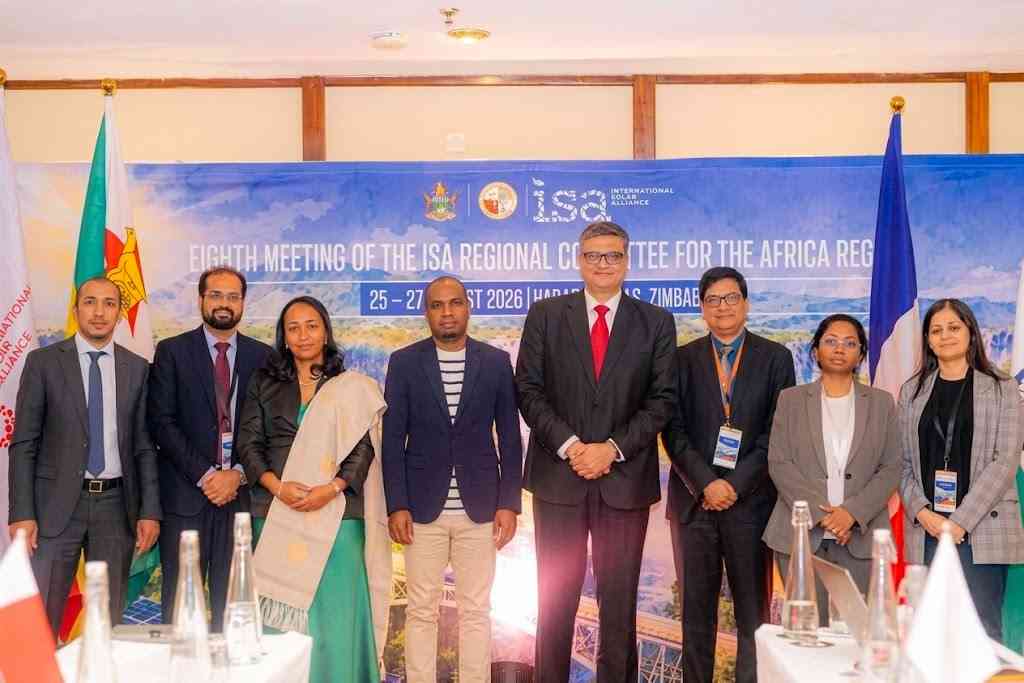
THE Eighth Regional Committee Meeting of the International Solar Alliance (ISA) took place in Victoria Falls from August 24 to 27, where over 45 African countries convened to advance solar energy deployment, investment, and energy access across the continent.
According to the ISA, the three-day meeting focused on translating policy commitments into practical action.
Discussions covered mini-grids, rooftop solar, utility-scale projects, solar-powered agriculture, energy storage, electric mobility, and local capacity building across Africa.
Our reporter Nizbert Moyo (NM) had an exclusive interview with the ISA Director General, Ashish Khanna (AK), to explore the critical issues that were at stake during the meeting. Below are excerpts from the interview.
NM: Given the significance of Zimbabwe hosting this summit—which brings together energy ministers and leaders from across 54 African countries—we are keen to provide our readers with in-depth insights into how this initiative will specifically impact Zimbabwe. In our conversation, I would like to focus on the following areas that are of high priority for the Zimbabwean context: Zimbabwe’s solar opportunity and translating this potential into commercially viable projects to expand energy access.
AK: First, let me explain briefly what the International Solar Alliance (ISA) is. It is a multilateral global organisation designed primarily by and for countries of the Global South to accelerate the deployment of solar energy.
We believe that countries must work together to increase the use of solar energy, because Africa must come together and resolve its own issues.
The alliance has 129 member countries, 54 of which are African, and member countries will be attending—even some non-members are coming to participate.
Due to the global crisis, many countries are trying to import a lot of diesel and petrol.
Currently, 75% of humanity depends on fuel, creating expenses of more than US$1 trillion. Everyone is trying to escape this crisis, and for the future, everyone is looking at one strategy that is cheap and abundant: solar.
Yet, two-thirds of this transition is not happening in Africa. It is not that Africa does not want it; actually, Africa needs it more than anyone else. Six hundred million Africans still do not have access to solar energy.
In Zimbabwe, half of the rural population lacks access to modern energy, but solar is the cheapest and fastest energy option, even through solar home systems.
The presidential 1.2 million solar system projects are currently being rolled out in Zimbabwe, and similar initiatives are being implemented in various other African countries.
Mini-grids are also being constructed in Zimbabwe, creating local jobs and income alongside solar irrigation.
Solar-powered pumps are incredibly important for Africa. Only 4% of arable land is irrigated in Africa, compared to 55% in India and 70% in China.
If Africa wants food security, it must have irrigation, and the cheapest and most sustainable way to achieve that is through solar-powered pumps.
Other countries are already doing it; India has done it. We want to create a programme for Zimbabwe.
We aim to install more than one million solar-powered agricultural water pumps across Africa by 2030 to improve irrigation, enhance food security, and increase the current low rate of irrigated arable land across the continent.
Seven countries will come together and sign a declaration prioritising the solarisation of agriculture, which will include pumps and cold storage systems. We have done this in other African countries where farmers previously lacked these resources.
Fossil fuels still supply approximately 80% of global energy, which closely aligns with the premise of humanity’s massive fuel dependence, and the financial impacts are indeed breaching the trillion-dollar mark across multiple sectors.
The second important element is financing. Everybody knows what they want to do, but they cannot do it because of a lack of financing.
Regarding finance, one thing that is very important to understand in Africa is that many governments need to work with the private sector to encourage investment, similar to what Zimbabwe is trying to do with independent power producer (IPP) solar and other ongoing projects.
We are signing the Africa Solar Facility in Zimbabwe, which will be managed by Africa50—an entity owned by 34 African governments.
We want to set up mini-grids and solar pumps, but a lack of finance remains a challenge. The Africa Solar Facility will provide equity support for all these companies because growth and jobs develop together.
Since the private sector may not always have the necessary skills, we will establish Solar Technology Application Resource Centres (STAR-C).
Ten of them are already operational in African countries, and the eleventh one will be opened in Zimbabwe.
That centre will become the base where new policies, regulations, research, and training will take place. We will design a programme on how to maintain them, including involving philanthropists.
Energy is about creating an ecosystem, and by having a coherent policy, it means that for the next 25 years, we will be identifying which other top priorities should be considered in Zimbabwe.
There is a vital need for the rural population to gain access to energy through STAR-C—which stands for a global network of Solar Technology Application Resource Centres—ensuring good quality products, including solar rooftop systems.
These are different measures which need complete implementation.
NM: Let's explore how solar-powered irrigation and agricultural photovoltaics (Agri-PV) can enhance our agricultural productivity, ensure food security, and reduce reliance on conventional energy. How can solar address rural electrification?
AK: The majority of Zimbabweans in agriculture are in rural areas, but their income levels are low. One of the reasons for this is that they are primarily dependent on rainfall.
I visited Uganda and met farmers whom we had supplied with solar pumps. They told me that because they can now grow crops twelve months a year, their income levels have grown.
That is all possible if farmers are connected to irrigation with solar pumps. Building dams costing billions of dollars and using diesel-based pumps is simply not feasible. The cheapest and fastest way to farm is by using solar pumps.
We have a policy in which the government will prioritise solar-powered pumps and some form of financing.
We will work on how farmers can access solar power procurement, who will supply, and who will maintain them.
We also work with STAR-C centres to train local people so that once solar pumps are installed, there is someone to take care of them.
Agri-PV (short for agricultural photovoltaics or agrivoltaics) is a dual-use method that combines solar power generation and farming on the exact same piece of land at the same time.
NM: How do you assess the viability of solar mini-grids as a path to provide reliable electricity to communities currently beyond the national grid?
AK: Given that Zimbabwe still has only 50% rural access to energy, and people live far apart, it is expensive to connect them to the national grid.
The only way these communities can get access is by providing them with solar home systems. Through this, they will get light, a fan, and a charger.
NM: How can we make Zimbabwean solar projects more bankable, and what role can initiatives like the Africa Solar Facility play in moving projects from planning to implementation?
AK: The government has come out with a clear target of 2 700 MW of solar projects by 2030 through solar power companies or other utilities.
NM: What are the employment opportunities and technical skills that solar expansion will create for the Zimbabwean workforce?
AK: A study has shown that seven million jobs can be created in Africa by 2030 through solarisation. This will come through regulators and other policymakers, those who can prepare tenders, and the private sector winning those tenders with their workforce.
All of these require local people to work, including financiers. There are many skills needed, including the digitalisation that is already happening in other countries.
NM: How can emerging technologies like AI, digitalisation, and batteries accelerate Zimbabwe’s clean energy transition?
AK: Zesa (Zimbabwe Electricity Supply Authority) is now enabling solar rooftop systems, but the grid was not originally designed to capture this power. Imagine if hundreds of people in Harare start selling electricity back; the grid does not know how to manage that.
If we create AI tools and digitalisation apps, the system will understand how to manage power, which is absolutely essential.
Another important aspect is the consumer.
For example, a farmer can switch power off and on using a mobile phone.
Consumers who have solar rooftops in India have developed apps that allow them to sell power to anyone who offers them the most money. We want to create all these solutions and make them available for free.
NM: What are your parting words?
AK: For far too long, Africa has felt energy is important but could not do anything to collectively address it. The political will is now very strong.
Everyone understands that fossil fuels are proving to be too expensive and, at times, unavailable. Therefore, the solar transition is the cheapest and fastest way forward; no one can survive without energy. In the history of humankind, energy is the backbone of any economy.
My parting point is that I would like to see Africa, including Zimbabwe, double its solar energy production every single year